


 English
 Türkçe
 русский
 العربية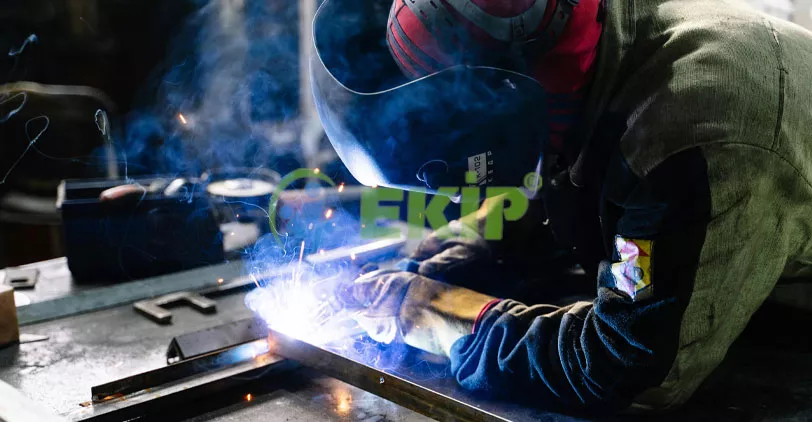
SOURCE OF STAINLESS STEELS
Stainless steels and heat-resistant steels can be welded using melting and pressure welding methods employed in non-alloyed and low-alloy steels, except for some limitations. The welding process of stainless and heat-resistant steels may vary according to the expected properties of the base metal to be welded, such as corrosion and heat resistance. The welding material to be used should have the same composition as the base metal or be more highly alloyed for some applications.
The surface of stabilized stainless steels and welding metal cannot be polished too much,
Stabilized stainless steels can be welded with both welding materials of the same composition and low-carbon welding materials,
Low-carbon stainless steels should be welded only with low-carbon welding materials if possible,
Nitrogen (N)-alloyed stainless steels should be welded with normal (N-non-alloyed) welding materials that have sufficiently high mechanical properties. The mixture with the base metal should be kept as low as possible.
Due to its high thermal expansion, tack welding should be done with short passes to reduce deformation.
Because of its low thermal conductivity, it causes excessive heat accumulation in the welding area, thus the heat input should be limited.
Post-weld heat treatment is necessary to achieve a clean metallic surface, thereby obtaining a flawless passive surface.
